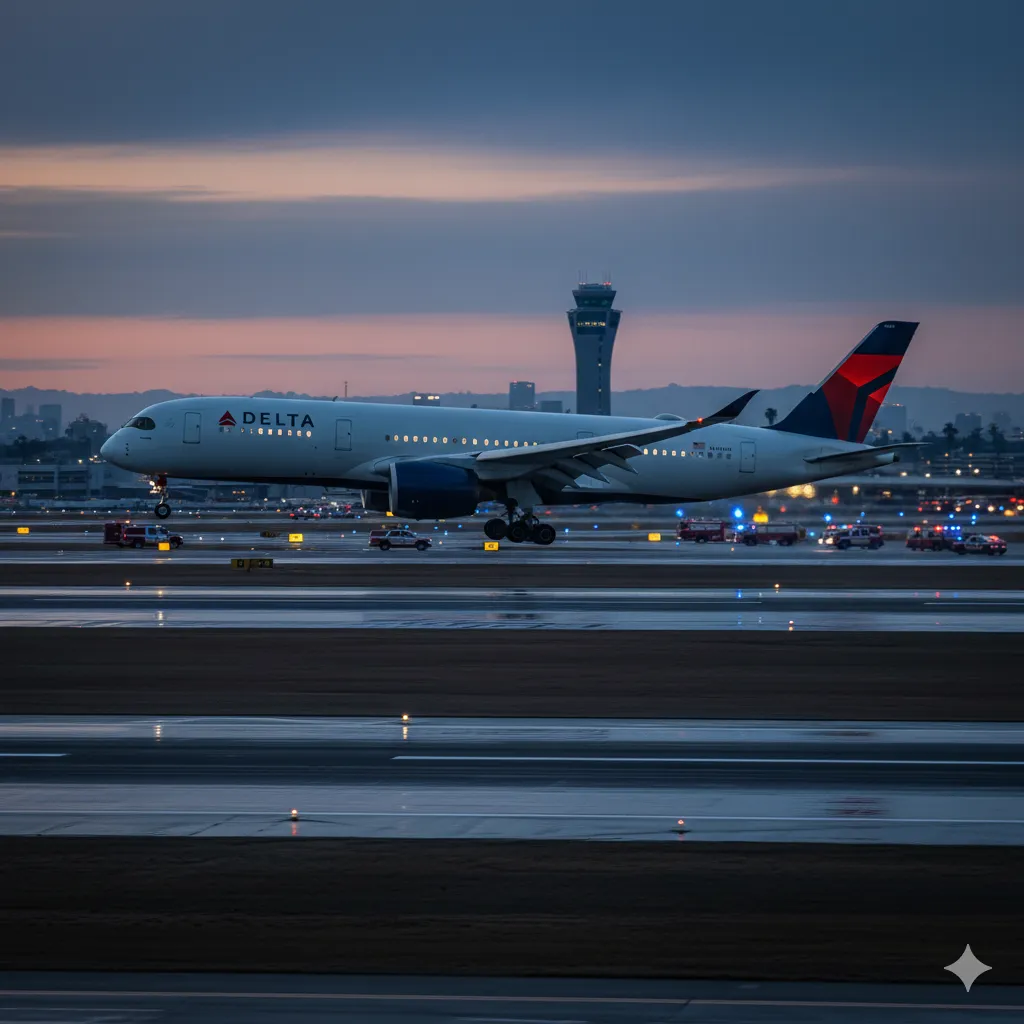
Air travel rarely goes off-script, especially for global carriers like Delta Air Lines. Yet, even in the most advanced aircraft, safety and precision must always come first. When Delta Flight DL275, a scheduled service from Detroit (DTW) to Tokyo (HND), unexpectedly diverted to Los Angeles International Airport (LAX), it caught the attention of aviation enthusiasts and passengers alike.
The incident raised key questions: What caused the diversion? Were passengers at risk? And how do major airlines like Delta handle such situations? In this article, we’ll unpack every detail from technical causes to passenger experiences and aviation safety procedures giving you the complete lowdown on how Delta Flight DL275’s diversion demonstrates the strength of modern aviation protocols.
Why Delta Flight DL275 Was Diverted to LAX
Flight DL275, operated on an Airbus A350-900, departed Detroit on a long-haul journey to Tokyo, a route spanning the Pacific Ocean and typically lasting about 13 hours.
A few hours into the flight, pilots identified an issue related to the aircraft’s engine anti-ice system — a crucial component that prevents ice from forming on engine parts at high altitudes. While not immediately life-threatening, this anti-ice failure triggered Delta’s strict ETOPS (Extended Operations) diversion policy, designed for long over-water flights where alternate airports are limited.
Rather than continue across the Pacific with a potential systems concern, the pilots decided to divert the aircraft safely to LAX, where maintenance crews and replacement parts were available.
This decision was not only precautionary but also fully aligned with FAA safety regulations and Delta’s internal safety protocols, showcasing the airline’s commitment to passenger and crew safety over schedule adherence.
Aviation Safety Protocols Behind the Decision
To understand the DL275 diversion, it helps to know how ETOPS (Extended-range Twin-engine Operational Performance Standards) governs long-haul flights.
ETOPS-certified aircraft, like the Airbus A350-900, can fly routes far from diversion airports — but only if all major systems, including the engine anti-ice, are functioning properly.
The DL275 diversion to LAX wasn’t a failure of technology; it was an example of aviation safety in action. The cockpit crew, following established Delta Air Lines procedures, executed the following steps:
- Detected the issue early: The onboard systems alerted the pilots to a possible fault in the engine’s anti-ice function.
- Evaluated ETOPS limits: Continuing across the Pacific without full redundancy could violate ETOPS safety thresholds.
- Diverted to the nearest major maintenance hub: LAX offered both runway capacity and the necessary Airbus support for quick resolution.
This series of actions exemplifies Delta’s proactive safety culture one that prioritizes redundancy, regulation, and risk mitigation over passenger inconvenience.
Passenger Experience During the Diversion
For most travelers, mid-air diversions can be stressful, but passenger accounts from DL275 paint a calm and professional picture. Cabin crew reportedly kept passengers informed throughout, explaining the reason for diversion and assuring that no immediate danger existed.
Upon landing at Los Angeles International Airport, passengers were provided refreshments, hotel accommodations, and rebooking assistance for connecting flights to Tokyo. Many shared positive remarks about Delta’s transparency and care, turning what could have been a negative experience into an example of operational excellence.
One passenger wrote on social media:
The captain explained everything clearly safety first, professionalism second to none. Delta handled it better than I expected.”
Such experiences reinforce the value of communication and empathy in aviation crucial components of maintaining trust during unforeseen situations.
Technical Insight: Engine Anti-Ice and Flight Safety
What Is the Engine Anti-Ice System?
At high altitudes, freezing temperatures can cause ice to form on critical parts of an aircraft’s engines. The engine anti-ice system uses hot air from the engine’s compressor to prevent this buildup.
Why Is It Important?
If ice forms unchecked, it can disrupt airflow and reduce engine efficiency, potentially leading to power loss or damage. While rare, such conditions require immediate attention especially on long-haul flights over oceanic routes.
What Happened on DL275
Reports suggest that one of the A350’s anti-ice valves malfunctioned, prompting the cockpit crew to restrict the flight from continuing across the Pacific.
Rather than risk losing ETOPS certification mid-route, they diverted to LAX, where ground technicians could inspect and repair the system.
This incident underscores how modern aviation technology empowers pilots to make data-driven, safety-first decisions in real time.
Delta’s Response and Maintenance Process
Once the aircraft landed, Delta Air Lines immediately coordinated with Airbus maintenance teams to assess the issue.
After inspection, the anti-ice valve was replaced, and the aircraft returned to service following comprehensive checks.
This swift resolution highlights Delta’s operational readiness and its commitment to maintaining fleet reliability. The airline operates one of the largest Airbus A350 fleets in the U.S., and its engineering teams are trained to handle complex international aircraft systems quickly and efficiently.
Moreover, Delta’s communication strategy — informing customers promptly via email, app notifications, and on-ground representatives demonstrated their customer-first philosophy even amid operational challenges.
What a Diversion Like DL275 Means for Aviation Safety
When a flight diverts, it’s easy for outsiders to assume something went “wrong.”
In truth, diversions like DL275’s LAX landing are proof that the aviation safety net works perfectly.
Key Lessons from DL275’s Diversion:
- Safety over schedule: The primary decision factor was risk management, not cost.
- Real-time decision-making: Pilots use live data and flight management systems to assess every possible outcome.
- Maintenance accessibility: LAX offered immediate access to Airbus-certified technicians and parts.
- Passenger management: Smooth communication prevented panic and maintained trust.
Each of these points reinforces how modern aviation prioritizes safety, precision, and transparency all crucial components of a well-regulated global travel industry.
Media Coverage and Public Reaction
When news of Delta Flight DL275’s diversion broke, aviation journalists and enthusiasts across social platforms like Twitter and Reddit quickly circulated updates.
While initial posts speculated about “mechanical failure,” Delta clarified that it was a precautionary diversion, not an emergency.
Media outlets praised Delta’s response, noting that no injuries occurred, the crew followed procedure, and passengers were cared for throughout.
This transparency helped prevent misinformation and strengthened public confidence in Delta’s operational integrity.
How Airlines Plan for Diversions
Even before takeoff, airlines prepare for any contingency including diversions like DL275’s.
Here’s how the process typically works:
- Flight planning software identifies alternate airports along the route.
- Fuel reserves are calculated to include potential diversion needs.
- ETOPS certification ensures twin-engine aircraft can safely operate far from land.
- Communication systems allow pilots to coordinate instantly with dispatch and ATC.
- Passenger protocols include updates, rebooking, and assistance upon landing.
These layers of planning ensure that even when something goes off-plan, safety remains absolute.
Why Los Angeles (LAX) Became the Chosen Diversion Point
When Delta Flight DL275 was forced to divert, Los Angeles International Airport wasn’t selected by chance. LAX serves as one of Delta’s key operational hubs, fully equipped to handle large aircraft such as the Airbus A350-900. The airport provides advanced maintenance facilities, experienced engineering teams, and immediate access to replacement parts — essential resources when a mechanical issue arises mid-flight. Reports indicate that the diversion decision was based on both safety and logistics. With multiple long runways, a robust emergency response system, and access to extensive passenger services, LAX offered the safest and most practical landing option over smaller regional airports. This strategic choice highlights how airlines prioritize both passenger safety and operational readiness when managing in-air technical irregularities.
The Real Cause: A Technical Issue in the Engine’s Anti-Ice System
Midway across the Pacific, Delta’s Airbus A350 detected irregularities within its engine anti-ice system a mechanism crucial for preventing ice buildup on engine components during high-altitude flights. When the system’s sensors began reporting pressure fluctuations and delayed valve responses, the cockpit crew followed established safety protocols and chose to divert rather than risk a trans-oceanic continuation with a compromised system. While the fault did not result in immediate danger, any malfunction involving the engine’s anti-ice system can impact performance and efficiency, particularly in cold and moisture-dense flight zones. The swift and calculated decision to head for LAX reflected Delta’s commitment to precautionary action and adherence to international flight safety standards.
Passengers Praised Crew for Calm, Clear Communication
For passengers on board, the unexpected diversion could have sparked panic, but eyewitness accounts suggest otherwise. Delta’s cabin crew reportedly maintained composure, informing travelers that the decision to land early was precautionary rather than emergency-driven. Their professionalism helped maintain a calm cabin atmosphere throughout the descent and landing. Once on the ground, passengers were met with coordinated ground support — hotel arrangements, rebooking options, and refreshments — ensuring minimal disruption to their journeys. Such proactive communication and care illustrate why Delta continues to earn high marks for customer service even during operational challenges. In an age where transparency defines trust, the airline’s approach to managing this situation stood out as a model example of crisis communication done right.
Looking Ahead: Lessons from DL275
Aviation professionals view Flight DL275’s diversion as a case study in operational excellence. The incident demonstrated how technology, training, and teamwork converge to maintain safety at every stage.
For passengers, it’s a reminder that behind every smooth flight lies an intricate network of pilots, engineers, dispatchers, and air traffic controllers all working toward one goal: getting everyone safely to their destination.
As airlines embrace predictive maintenance and AI-based diagnostics, incidents like this may become even rarer. But when they do occur, transparency and preparedness remain the keys to trust.
Realted Insight: United Airlines Flight UA770 Emergency Diversion: What Really Happened?
Conclusion: Safety First Always
The diversion of Delta Flight DL275 to LAX wasn’t a sign of failure it was a testament to modern aviation’s safety systems at work.
From the pilots’ quick judgment to Delta’s efficient response and the passengers’ calm cooperation, every aspect of the event showed how far air travel has evolved in safety and professionalism.
In an age where technology drives aviation, Delta’s proactive measures and transparent communication reaffirm why flying remains one of the safest modes of travel on Earth.
You also like: Travel Tweaks Hotels – Smart Tips to Upgrade Every Stay
FAQs
Q1: Why was Delta Flight DL275 diverted to LAX?
Because of a suspected engine anti-ice valve malfunction, the flight was diverted as a precaution to ensure ETOPS compliance and passenger safety.
Q2: Was the diversion an emergency?
No. It was a precautionary diversion, not an emergency landing. Passengers and crew were safe throughout.
Q3: What type of aircraft was Delta Flight DL275?
The flight was operated by an Airbus A350-900, one of the most advanced long-haul aircraft in Delta’s fleet.
Q4: How did Delta handle passenger accommodations?
Passengers were provided hotel stays, meals, and rebooking assistance, ensuring comfort until their journey resumed.
Q5: What does ETOPS mean in aviation?
ETOPS stands for Extended-range Twin-engine Operational Performance Standards rules that ensure safety during long overwater flights.