
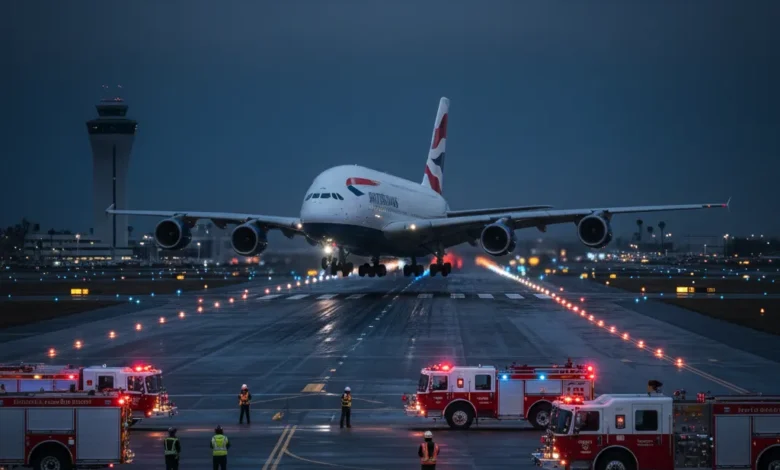
In the ever-dynamic world of aviation, emergencies are rare but unforgettable. Among these, British Airways flight BA286 stands out as one that captured public attention worldwide. Departing from San Francisco International Airport (SFO) and bound for London Heathrow (LHR), the Airbus A380—one of the world’s largest passenger aircraft—was forced to declare an emergency mid-flight.
Passengers and aviation enthusiasts alike were left asking: What exactly happened on British Airways flight BA286? From technical concerns to potential medical issues, this story unfolds as a real-life example of how airlines handle critical situations at 35,000 feet. In this in-depth article, we’ll dive into the event timeline, expert insights, aviation protocols, and lessons learned from the BA286 emergency.
Table of contents
- The Journey Begins: British Airways Flight BA286
- What Triggered the Emergency on BA286?
- Timeline of Events
- British Airways’ Emergency Response
- Aviation Protocols Behind “Squawk 7700”
- Lessons from the BA286 Incident
- Passenger Experiences: Calm Amid the Chaos
- Technical Side: Aircraft and Engineering Insights
- Media Coverage and Public Reaction
- British Airways’ Safety Record and Protocols
- Broader Implications for Air Travel
- Conclusion
- FAQs
The Journey Begins: British Airways Flight BA286
British Airways flight BA286 is a regular long-haul route connecting San Francisco to London. Operated by an Airbus A380-800, the flight typically carries hundreds of passengers across nearly 5,400 miles of airspace.
On the night of the incident, everything appeared normal as boarding concluded. Weather was clear, the aircraft (registration G-XLEG) underwent routine checks, and the crew prepared for another transatlantic journey.
Yet, hours into the flight, a chain of unexpected events would soon turn this ordinary journey into one of British Airways’ most widely discussed emergencies.
What Triggered the Emergency on BA286?
While the official reports describe the event as a “precautionary emergency,” the cause was linked to a potential technical issue. According to initial aviation tracking data, the BA286 squawked 7700, the international transponder code indicating an emergency situation.
Aviation experts note that a squawk 7700 doesn’t necessarily mean disaster—it signals the crew’s intention to alert air traffic control that something unusual or potentially serious is occurring onboard.
In BA286’s case, engine irregularities were first suspected. The Airbus A380 features four Rolls-Royce Trent 900 engines, and even minor anomalies trigger safety protocols. After detecting irregular engine readings, the pilots opted for an emergency diversion to Los Angeles International Airport (LAX).
Timeline of Events
1. Takeoff from San Francisco
Flight BA286 departed around 7:45 PM local time, following its standard path toward the North Atlantic route. All systems were initially nominal.
2. The In-Flight Alert
Roughly two hours into the flight, the crew observed anomalous readings from one of the engines. Following protocol, they coordinated with air traffic control and squawked 7700.
3. Diversion Decision
Given the aircraft’s size and the proximity of suitable runways, LAX was the chosen diversion airport. The A380’s weight and fuel load required a carefully managed descent and fuel burn procedure before landing.
4. Emergency Landing at LAX
Around midnight, BA286 touched down safely at Los Angeles International Airport. Fire crews and emergency vehicles awaited the aircraft as a standard precaution. No injuries were reported, and the passengers were deplaned calmly.
British Airways’ Emergency Response
British Airways’ response to the BA286 incident demonstrated textbook crisis management. Immediately after the landing, technical teams inspected the A380 while ground crews ensured passenger comfort.
- Communication Protocols: The flight crew maintained continuous contact with ATC and British Airways’ operations center in London.
- Passenger Care: The airline arranged overnight accommodations and rebooked connecting flights for all passengers.
- Technical Inspection: Engineers conducted a detailed inspection of the Rolls-Royce Trent engines, ruling out severe damage but identifying an anomaly in one of the performance sensors.
- Public Statement: Within hours, British Airways issued a statement confirming the diversion was a “precautionary measure” and that safety was never compromised.
This level of transparency and efficiency reinforced confidence in the airline’s operational excellence.
Aviation Protocols Behind “Squawk 7700”
When a pilot transmits a 7700 emergency code, air traffic controllers immediately give priority handling. The code communicates a universal alert whether it’s a medical emergency, technical malfunction, or crew distress.
In the case of BA286, the quick response from both the flight crew and air traffic control exemplified how aviation systems are designed to prevent escalation.
Pilots train extensively for such scenarios, running simulations that prepare them for every possible outcome, including engine failure, hydraulic loss, or depressurization. The efficiency displayed by the BA286 crew is a testament to modern aviation training and resilience.
Lessons from the BA286 Incident
While the situation was resolved without injuries, it highlighted key aspects of air travel safety:
- Redundancy in Aircraft Systems: The A380’s design includes multiple fail-safes, ensuring continued flight even with one malfunctioning engine.
- Proactive Decision-Making: The BA286 crew’s decision to divert early prevented further complications.
- Passenger Preparedness: Emergency briefings and calm communication reduced panic among travelers.
- Airline Transparency: Quick and clear statements build passenger trust and public credibility.
This event served as a reminder that emergencies, while rare, are managed through precision and professionalism.
Passenger Experiences: Calm Amid the Chaos
Passengers later described the BA286 diversion as “smooth and reassuring.” Despite hearing about an emergency landing, most travelers noted that the crew remained composed throughout.
One passenger told aviation reporters:
“The captain explained everything clearly. We knew something was up, but the landing was so gentle that it didn’t feel like an emergency.”
Social media posts from onboard confirmed the absence of panic, and praise poured in for British Airways’ staff for maintaining calm communication and professionalism.
Technical Side: Aircraft and Engineering Insights
The Airbus A380, operating as BA286, is known for its robust engineering and redundancy systems. Even a single engine issue doesn’t threaten flight safety thanks to the aircraft’s design.
British Airways’ maintenance logs showed the plane underwent inspection at LAX, including:
- Engine diagnostics via Rolls-Royce monitoring software.
- Fuel system recalibration.
- Sensor replacement and flight data analysis.
After clearance, the aircraft resumed service within 48 hours underscoring the efficiency of British Airways’ technical team.
Media Coverage and Public Reaction
News outlets across the U.S. and U.K. covered the BA286 incident extensively. Aviation reporters praised the crew’s professionalism, while experts analyzed the incident as a “case study in safety culture.”
On platforms like Twitter and Reddit, passengers shared their experiences, while flight-tracking enthusiasts monitored the aircraft’s emergency transponder activity in real time.
British Airways’ Safety Record and Protocols
British Airways has long been recognized for its exemplary safety record, supported by:
- Rigorous maintenance schedules.
- Continuous pilot training and simulator exercises.
- Global safety audits under IATA and EASA standards.
- Collaboration with aircraft manufacturers like Airbus and Rolls-Royce.
The BA286 emergency reaffirmed the airline’s dedication to safety first, comfort second, and transparency always.
Broader Implications for Air Travel
Incidents like British Airways flight BA286 remind us that even with advanced technology, human expertise remains vital. As aircraft become more digitalized, pilot decision-making and engineering oversight still play central roles in ensuring passenger safety.
The incident also reinforced traveler trust knowing that even in emergencies, systems are designed to protect lives first and foremost.
Here’s how you can create an internal link to your previous article on Delta Air Lines Flight DL275:
As seen when British Airways Flight BA286 was diverted, safety and procedure go hand-in-hand. Similarly, for more on Delta’s in-air emergency and precautionary landing, see “Delta Flight DL275 Diverted to LAX: What Really Happened”.
Conclusion
The story of British Airways emergency flight BA286 is not one of disaster but of discipline, communication, and confidence. In the face of uncertainty, every link in the aviation safety chain performed flawlessly.
From the pilots who made decisive calls to the ground teams who ensured every passenger’s comfort, BA286 stands as a reminder that aviation safety isn’t just about technology — it’s about people.
British Airways once again demonstrated why it remains among the most trusted names in global aviation. For passengers, this event only reinforced a truth long known to frequent flyers: when you’re 35,000 feet in the air, professionalism matters most.
FAQs
Q1: What caused the British Airways BA286 emergency?
The emergency was due to a potential engine performance irregularity, prompting a precautionary diversion to Los Angeles.
Q2: Was anyone injured on British Airways flight BA286?
No one suffered any injuries. The crew managed the situation calmly, and ground staff quickly accommodated all passengers after the safe landing at Los Angeles International Airport.
Q3: What type of aircraft operates BA286?
British Airways operates the Airbus A380-800 on the BA286 route between San Francisco and London. The aircraft’s size, reliability, and safety systems make it ideal for long-haul transatlantic flights.
Q4: What does a “squawk 7700” alert mean?
Pilots send a “squawk 7700” code to air traffic control when they face an emergency in flight. This alert tells controllers to give the aircraft immediate priority and assistance.
Q5: Did flight BA286 continue to London afterward?
After engineers completed safety checks and cleared the aircraft, British Airways rebooked passengers on another flight to London the next day.