When you purchased your home, you probably inspected the foundation, tested the plumbing, and checked the electrical system. But did you think to ask about what’s hiding inside your walls, wrapped around your pipes, or embedded in your ceiling tiles? For millions of homeowners living in properties built before the 1990s, there’s an invisible threat that demands attention: asbestos-containing materials, including asbestos tape and insulation commonly referred to in industry circles as asbestlint.
Understanding what asbestos is, where it lurks, and how modern science is revolutionizing its detection can mean the difference between a safe home and a health crisis decades in the making.
Table of contents
- What Exactly Is Asbestos and Why Was It Everywhere?
- Devastating Health Reality Behind the Miracle Material
- Where Asbestos Hides in Your Home
- Critical Mistake: Why DIY Detection and Removal Can Kill
- Revolutionary Detection Technology: Seeing Invisible Without Risk
- Professional asbestlint Management: What Safe Removal Actually Looks Like
- What to Do If You Suspect asbestlint in Your Home
- Legal Protections and Your Rights
- The Path Forward: Creating Safer Spaces
- Conclusion
- FAQs
What Exactly Is Asbestos and Why Was It Everywhere?
Asbestos isn’t a single substance but rather a family of six naturally occurring fibrous silicate minerals. For nearly a century, these minerals were considered industrial miracles. They were strong yet flexible, completely resistant to heat and electricity, impervious to chemical corrosion, and remarkably inexpensive. These properties made asbestos the darling of the construction, automotive, and manufacturing industries throughout the 20th century.
Walk into any building constructed between 1930 and 1980, and you’re likely standing in a structure that contains asbestos in multiple forms. It was woven into vinyl floor tiles for durability, sprayed onto steel beams as fireproofing, wrapped around heating pipes as insulation. It mixed into ceiling tiles and roofing shingles, and even incorporated into adhesives and joint compounds. Asbestos tape, specifically, became a standard material for insulating pipe joints and sealing ductwork due to its exceptional heat resistance.
The construction industry wasn’t the only sector enamored with this mineral. Automobile manufacturers used it in brake pads and clutches. Consumer product companies incorporated it into hair dryers, ironing board covers, and oven mitts. It seemed there was no limit to asbestos applications.
Devastating Health Reality Behind the Miracle Material
The dark side of this miracle material emerged gradually, then all at once. When asbestos-containing materials remain intact and undisturbed, they pose minimal risk. The danger begins when these materials deteriorate, are cut, sanded, drilled, or demolished. During these disturbances, microscopic asbestos fibers become airborne, creating an invisible toxic cloud that can be inhaled or ingested.
These fibers are microscopically small—far thinner than a human hair—and once they enter your respiratory system, they become permanently lodged in lung tissue. Your body cannot break them down or expel them. Over years and decades, these embedded fibers cause chronic inflammation and cellular damage that manifests as life-altering diseases.
Asbestosis develops when accumulated scar tissue in the lungs makes breathing progressively more difficult. There is no cure, and the condition is irreversible. Lung cancer linked to asbestos exposure claims thousands of lives annually, with smokers facing exponentially higher risk. But perhaps the most devastating diagnosis is mesothelioma, an aggressive and almost universally fatal cancer that attacks the lining of the lungs, heart, or abdomen.
The cruelest aspect of these diseases is their latency period. Someone exposed to asbestos fibers during a home renovation in 1985 might not experience symptoms until 2025 or later. We are today diagnosing illnesses from exposures that occurred 30, 40, even 50 years ago. This time bomb effect means that every year, thousands of people who thought they were healthy receive terminal diagnoses from exposures they’ve long forgotten.
Where Asbestos Hides in Your Home
If your home was built or renovated before 1990, the probability of asbestos-containing materials being present is significant. Understanding where to look is the first step in protecting your family.
Asbestos insulation wrapped around furnace ducts, boiler units, and hot water pipes was standard practice for decades. This thermal insulation often appears as a gray or white paper-like material or corrugated wrapping. In basements and utility rooms, you might find it coating exposed pipes throughout the space.
Flooring materials represent another common source. Those attractive 9×9 or 12×12 inch vinyl tiles popular in kitchens and bathrooms from the 1950s through the 1980s frequently contained asbestos.
You also like this: Why Axurbain Could Be the Future Every City Needs
Critical Mistake: Why DIY Detection and Removal Can Kill
When homeowners discover potential asbestos materials, the natural instinct is often to “just take care of it” themselves. This impulse, while understandable, can transform a contained risk into a catastrophic exposure event.
Traditional asbestos identification required physically breaking off samples of suspect materials and sending them to laboratories for microscopic analysis. This process itself created the very hazard it was meant to assess. Every chip, cut, or scrape released fibers into the air. The sample might take days to analyze, during which time the homeowner and family could be breathing contaminated air.
Amateur removal attempts are even more dangerous. Asbestos fibers are 1,200 times thinner than a human hair and completely invisible to the naked eye. When you tear down that ceiling tile or rip out that floor tile, you cannot see the toxic cloud you’re creating. Standard dust masks purchased at hardware stores offer virtually no protection against asbestos fibers. The microscopic particles easily penetrate ordinary barriers and can contaminate your entire home through HVAC systems.
Revolutionary Detection Technology: Seeing Invisible Without Risk
For decades, the asbestos management industry was trapped in a paradox: the only way to test for asbestos was to create the exact disturbance that made it dangerous. But emerging technology is fundamentally changing this equation.
Advanced detection systems using Laser-Induced Breakdown Spectroscopy (LIBS) represent a quantum leap forward in asbestos identification. Instead of breaking off samples with hammers and chisels, these sophisticated instruments can analyze materials from a safe distance using precisely focused laser pulses.
The process is elegant in its simplicity and revolutionary in its impact. A technician points the handheld device at suspect material—a section of pipe insulation, a ceiling tile, a piece of flooring. The device emits a brief, focused laser pulse that vaporizes a microscopic amount of material, smaller than a pinprick. This creates a tiny plasma cloud of excited atoms that emit light at wavelengths unique to their elemental composition. An onboard spectrometer analyzes this light signature in real-time, and artificial intelligence trained on vast libraries of known materials instantly identifies whether asbestos is present and even specifies which type.
The entire process takes seconds and releases negligible, if any, respirable fibers. There’s no physical damage to the material, no waiting days for laboratory results, and critically, no hazardous exposure during testing.
Professional asbestlint Management: What Safe Removal Actually Looks Like
When asbestos-containing materials must be removed or disturbed for renovation or repair, professional asbestos abatement is not optional—it’s legally required in most jurisdictions and absolutely essential for health protection.
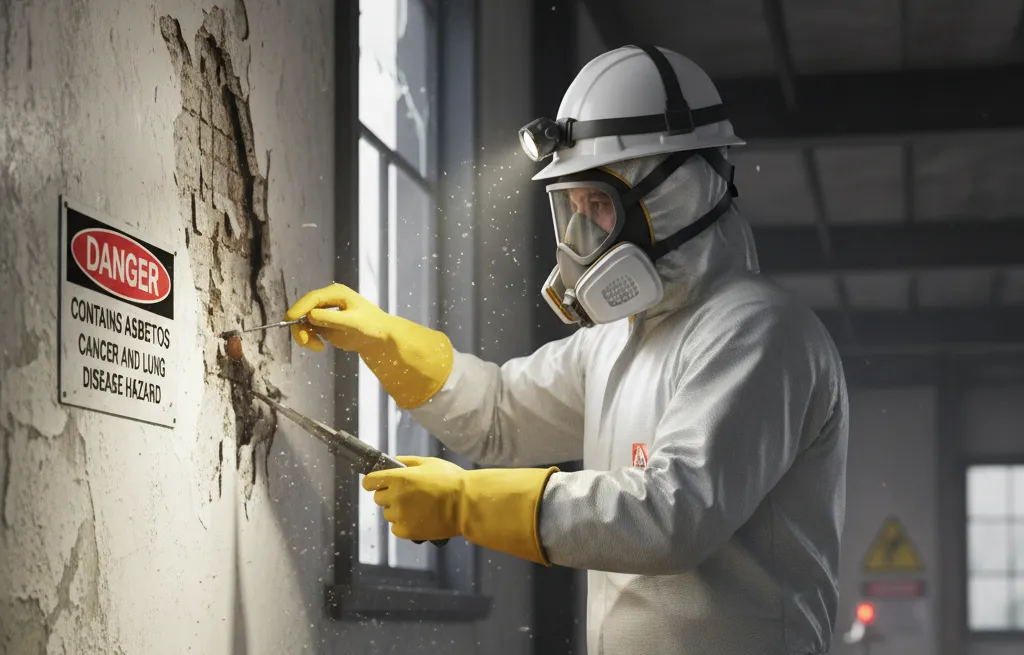
Certified abatement professionals follow strict protocols designed to contain every microscopic fiber. The work area is completely sealed with heavy plastic sheeting, creating a containment zone with negative air pressure systems that continuously filter the air and prevent any fibers from escaping to other parts of the building. Workers wear full-body protective suits and respirators equipped with HEPA filters specifically designed to trap asbestos fibers.
The removal process itself is methodical and slow. Materials are carefully wetted with specialized solutions that prevent fibers from becoming airborne. Every piece of removed material is immediately double-bagged in specially marked disposal containers that meet EPA requirements. After removal, the entire containment area undergoes rigorous air quality testing to verify that fiber levels are safe before the barriers come down.
Professional abatement companies carry specialized licenses, maintain comprehensive insurance, and must comply with regulations from OSHA, the EPA, and state environmental agencies. They dispose of asbestos waste only at approved facilities equipped to handle hazardous materials. The process is expensive, often costing thousands or even tens of thousands of dollars depending on the scope, but the alternative exposure to a substance that can kill you decades later—makes the investment non-negotiable.
What to Do If You Suspect asbestlint in Your Home
Discovery of potential asbestos materials should prompt immediate action, but not immediate removal. The first and most important rule is: do not disturb it. Asbestos materials that are intact and in good condition pose minimal risk. The danger increases exponentially when they’re broken, cut, sanded, or torn.
Document what you’ve found with photographs, noting the location and condition of the materials. Do not attempt to take samples yourself. Instead, contact a certified asbestos inspector who can safely collect samples and arrange for laboratory analysis or utilize advanced non-invasive testing technology.
While awaiting professional assessment, do not vacuum, sweep, or dust the area. These activities can disturb settled fibers and create new exposures. If the suspected material is in an area you must use, cover it with plastic sheeting secured with duct tape, but avoid direct contact with the material itself.
Legal Protections and Your Rights
The recognition of asbestos dangers prompted comprehensive regulatory frameworks designed to protect public health. The Asbestos Hazard Emergency Response Act (AHERA) mandates inspection and management plans for schools. The Occupational Safety and Health Administration (OSHA) enforces strict workplace exposure limits and requires employer protection measures. The Environmental Protection Agency (EPA) regulates asbestos abatement, disposal, and sets standards for building renovations and demolitions.
These regulations give you important rights. Landlords must disclose known asbestos-containing materials in rental properties. Home sellers in many states must inform buyers about asbestos presence or the lack of knowledge about potential asbestos. Employers must provide appropriate protective equipment and training for workers who might encounter asbestos.
If you or a family member develops an asbestlint-related disease, you have legal recourse. Specialized attorneys handle asbestos litigation, pursuing compensation from manufacturers, employers, or property owners whose negligence led to exposure. These cases have resulted in billions of dollars in settlements and verdicts, though no amount of money can restore health stolen by asbestos disease.
The Path Forward: Creating Safer Spaces
The asbestos legacy reminds us that the materials we choose today shape the health outcomes of generations tomorrow. Modern construction has largely abandoned asbestos in favor of safer alternatives like fiberglass insulation, mineral wool, cellulose-based materials, and synthetic polymer products that provide similar benefits without the devastating health consequences.
Education remains the most powerful tool in preventing exposure. Building owners, maintenance workers, renovation contractors, and homeowners all need to understand where asbestos might exist, how to recognize it, and what steps prevent dangerous disturbances. School programs, community workshops, and readily available testing services all contribute to a culture of awareness that protects public health.
Conclusion
The story of asbestos is simultaneously a cautionary tale about the unintended consequences of industrial progress and an encouraging demonstration of how science, regulation, and technology can address even the most insidious environmental health threats.
Your home should be your sanctuary, not a source of hidden danger. Understanding where asbestos might exist, recognizing the serious health risks associated with exposure, and knowing how to access modern detection and professional removal services transforms abstract concern into actionable protection for you and your family.
FAQs
1. What exactly is asbestlint, and is it the same as asbestos?
Asbestlint is an industry term commonly used to refer to asbestos tape or asbestos ribbon materials that were widely used for insulating pipe joints, sealing ductwork, and wrapping heating systems. While “asbestlint” isn’t an official scientific term, it’s become shorthand for asbestos-containing tapes and fibrous wrapping materials found in older buildings. All forms of asbestos—whether in tape, insulation, tiles, or other materials—contain the same dangerous microscopic fibers that pose serious health risks when disturbed.
2. How can I tell if my home contains asbestos without hiring a professional?
Unfortunately, you cannot reliably identify asbestos just by looking at it. Asbestos fibers are microscopic and materials containing asbestos often look identical to asbestos-free alternatives. The only way to know for certain is through professional testing using laboratory analysis or advanced spectroscopy technology. However, you can assess risk based on your home’s age: if your house was built or renovated between 1930 and 1990, there’s a significant probability that asbestos-containing materials are present, particularly in insulation, flooring, ceiling tiles, and pipe wrapping.
3. Is it safe to live in a house that contains asbestos materials?
Yes, it can be safe to live in a home with asbestos materials, provided those materials remain intact, undisturbed, and in good condition. Asbestos only becomes dangerous when it’s damaged, deteriorating, or disturbed in ways that release fibers into the air. Many homes built before 1990 contain asbestos materials that have been safely in place for decades. The key is knowing where these materials are located and ensuring they’re not damaged during routine maintenance, renovations, or repairs. Regular monitoring and proper management by professionals can allow you to live safely in a home with asbestos present.
4. What are the early warning signs of asbestos exposure?
This is one of the most frightening aspects of asbestos exposure: there are typically no immediate symptoms. Asbestos-related diseases have latency periods ranging from 10 to 50 years, meaning symptoms may not appear until decades after exposure. When symptoms do develop, they often include persistent coughing, shortness of breath, chest tightness, chest pain, difficulty swallowing, unexplained weight loss, and fatigue. If you know you’ve been exposed to asbestos, it’s crucial to inform your doctor and undergo regular chest X-rays and lung function tests, even if you feel perfectly healthy.
5. How much does professional asbestos testing cost?
Professional asbestos testing typically ranges from $200 to $800 for a residential property, depending on the size of your home, the number of samples needed, and your geographic location. Basic testing involves collecting 3-5 samples from suspect materials and sending them to an accredited laboratory for polarized light microscopy (PLM) analysis. More comprehensive inspections of larger properties or those requiring extensive sampling can cost $1,000 or more. Some companies now offer advanced on-site testing using laser spectroscopy technology, which provides immediate results but may cost slightly more.